Stack Data Structure in Rust
About This Module
This module introduces the stack data structure, a fundamental Last-In-First-Out (LIFO) container. Students will learn about stack operations, computational complexity, and multiple implementation strategies using both linked lists and vectors. The module explores the trade-offs between different implementations and demonstrates practical applications of stacks in programming and data science.
Prework
Before this lecture, please read:
- (Review) The Rust Book Chapter 8.1: "Storing Lists of Values with Vectors" - https://doc.rust-lang.org/book/ch08-01-vectors.html
- (Review) Rust std::collections documentation - https://doc.rust-lang.org/std/collections/index.html
Pre-lecture Reflections
- What are some real-world examples where LIFO behavior is useful?
- How might stack implementation affect performance in different scenarios?
- What are the memory layout differences between stack implementations using vectors vs. linked lists?
Learning Objectives
By the end of this lecture, you should be able to:
- Understand the LIFO principle and stack operations
- Implement stacks using different underlying data structures
- Analyze the computational complexity of stack operations
- Compare performance characteristics of vector-based vs. linked list-based stacks
- Choose appropriate stack implementations based on use case requirements
Stacks
- A Stack is a container of objects that are inserted and removed according the LIFO (Last In First Out) principle
- Insertions are known as "Push" operations while removals are known as "Pop" operations
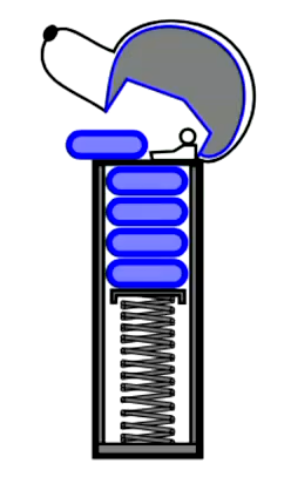
Universal Stack Operations
Stack operations would be along the lines of:
- push(object): Insert object onto top of stack. Input: object, Output: none
- pop(): Remove top object from stack and return it. Input: none, Output: object
- size(): Number of objects in stack
- isEmpty(): Return boolean indicated if stack is empty
- top() or peek(): Return a reference to top object in the stack without removing it
Question: Which Rust data structure could we use to implement a stack?
Computational complexity of Stack operations
Assume we are using a singly (or doubly) linked list
- Push: O(1)
- Pop: O(1)
- Size: O(1) (keep an auxiliary counter)
- isEmpty: O(1)
- top: O(1)
Using Vectors to implement a stack
- Implementing a stack using a vector is straightforward.
- We can build on
Vec<T>methods.
#![allow(unused)]
fn main() {
#[derive(Debug)]
pub struct Stack<T> {
    v: Vec<T>,
}

impl <T> Stack<T> {
    pub fn new() -> Self {
        Stack {v : Vec::new() }

    }
    pub fn push(&mut self, obj:T) {
        self.v.push(obj)
    }

    pub fn pop(&mut self) -> Option<T> {
        return self.v.pop();
    }

    pub fn size(&mut self) -> usize {
        return self.v.len();
    }

    pub fn isEmpty(&mut self) -> bool {
        return self.v.len() == 0;
    }

    pub fn top(&mut self) -> Option<&T> {
        return self.v.last()
    }
}
}
Using our stack implementation
Now let's use it!
#[derive(Debug)]
pub struct Stack<T> {
    v: Vec<T>,
}

impl <T> Stack<T> {
    pub fn new() -> Self {
        Stack {v : Vec::new() }

    }
    pub fn push(&mut self, obj:T) {
        self.v.push(obj)
    }

    pub fn pop(&mut self) -> Option<T> {
        return self.v.pop();
    }

    pub fn size(&mut self) -> usize {
        return self.v.len();
    }

    pub fn isEmpty(&mut self) -> bool {
        return self.v.len() == 0;
    }

    pub fn top(&mut self) -> Option<&T> {
        return self.v.last()
    }
}

fn main() {
    let mut s: Stack<i32> = Stack::new();

    println!("Pushing 13, 11, and 9\n");
    s.push(13);
    s.push(11);
    s.push(9);

    println!("size: {}", s.size());
    println!("isEmpty: {}", s.isEmpty());

    println!("\ntop: {:?}", s.top());
    println!("pop: {:?}", s.pop());
    println!("size: {}", s.size());

    println!("\ntop: {:?}", s.top());
    println!("pop: {:?}", s.pop());
    println!("size: {}", s.size());

    println!("\ntop: {:?}", s.top());
    println!("pop: {:?}", s.pop());
    println!("size: {}", s.size());
    println!("isEmpty: {}", s.isEmpty());

    println!("\ntop: {:?}", s.top());
    println!("pop: {:?}", s.pop());
}
Which implementation is better: LinkedList or Vec?
- Computation complexity is the same for both (at least on average)
- The Vector implementation has the occasional long operation which may be undesirable in a real-time system
BUT the most important consideration is spatial locality of reference.
- In a vector objects will be contiguous in memory so accessing one will fetch its neighbors into the cache for faster access
- In the linked list version each object is allocated independently so their placement in memory is unclear
In-Class Poll
True or False:
-
In a stack, the most recently added element is the first one to be removed.
- True ✓ (This is the definition of LIFO - Last In First Out)
-
The pop() operation on a stack has O(n) time complexity when using a singly linked list implementation.
- False ✗ (pop() is O(1) for both linked list and vector implementations)
-
A vector-based stack implementation may occasionally have long operations due to resizing.
- True ✓ (When the vector needs to grow, it must allocate new memory and copy elements)
-
The top() or peek() operation removes the top element from the stack.
- False ✗ (top/peek only returns a reference without removing the element; pop removes it)
-
Vector-based stacks generally have better spatial locality of reference than linked list-based stacks.
- True ✓ (Vector elements are contiguous in memory, improving cache performance)
Recap
- Stacks are a fundamental data structure
- They are implemented using a vector or a linked list
- They are a Last-In-First-Out (LIFO) data structure