Binary Heap Implementation
About This Module
This module explores the binary heap data structure, which is the foundation of efficient priority queue implementations. We'll examine the binary heap's tree structure, array-based storage, and implement core operations like push and pop with O(log n) complexity.
Prework
Prework Reading
Read the following sections from "The Rust Programming Language" book:
- Chapter 8.1: Storing Lists of Values with Vectors
- Chapter 10.1: Generic Data Types
- Chapter 10.2: Traits: Defining Shared Behavior
Pre-lecture Reflections
Before class, consider these questions:
- Why is the binary heap structure optimal for priority queue operations?
- How does the complete binary tree property enable efficient array-based storage?
- What are the key invariants that must be maintained in a max heap?
- How do the parent-child index relationships work in array representation?
- What are the trade-offs between binary heaps and other priority queue implementations?
Lecture
Learning Objectives
By the end of this module, you should be able to:
- Understand the binary heap structure and its key properties
- Navigate binary heap using array indices for parent and child nodes
- Implement heapify operations to maintain heap ordering
- Build push and pop operations with O(log n) complexity
- Analyze the relationship between tree height and operation complexity
- Compare custom implementations with Rust's standard library BinaryHeap
Popular implementation: binary heap
Binary heaps
- Data organized into a binary tree (one root, each node with 0, 1 or 2 children)
- Every internal node not smaller (or greater) than its children
- Every layer is filled before the next layer starts
Basic property:
The root has the current maximum (minimum), i.e., the answer to next pop
![[picture of basic binary heap with heap ordering]](images/order.png)
Heap storage properties
Efficient storage:
-
Tree levels filled from left to right
-
Can be mapped to a vector
-
Easy to move to the parent or children using vector indices
![[picture of basic binary heap with heap ordering]](images/layers.png)
![[picture of basic binary heap with heap ordering]](images/indices.png)
How are operations implemented?
Push
- add at the end the vector
- fix the ordering by swapping with the parent if needed
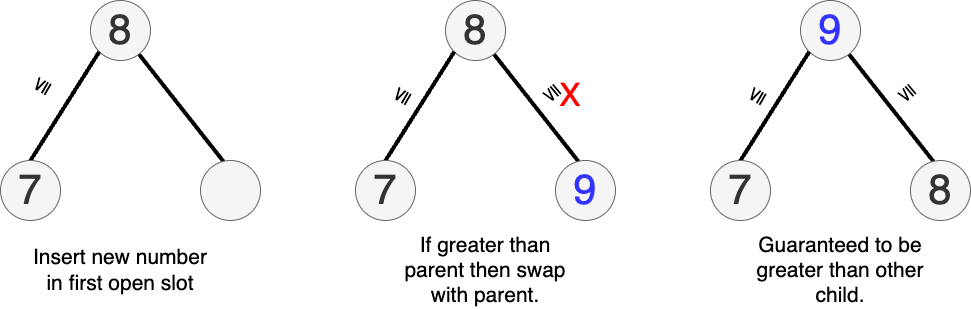
Pop
- remove and return the root
- replace with the last element
- fix the ordering by comparing with children and swapping with each that is greater
Complexity of push and pop
-
Proportional to the number of levels
-
So
Implementation
Utility methods
#![allow(unused)]
fn main() {
#[derive(Debug)]
struct MyBinaryHeap<T> {
    heap: Vec<T>,
    heap_size: usize,
}

impl<T> MyBinaryHeap<T> {
    fn new() -> MyBinaryHeap<T> {
        let heap: Vec<T> = vec![];
        let heap_size = 0;
        MyBinaryHeap { heap, heap_size }
    }

    // left child
    fn left(i: usize) -> usize {
        2 * i + 1
    }

    // right child of node i
    fn right(i: usize) -> usize {
        2 * i + 2
    }

    //parent of  node i
    fn parent(i: usize) -> usize {
        (i - 1) / 2  // integer divide
    }
}
}
Heapify -- Put everything in proper order
Make it so children are parents.
#![allow(unused)]
fn main() {
impl<T:PartialOrd+PartialEq+Copy> MyBinaryHeap<T> {
    fn heapify(&mut self, loc: usize) {
        let l = Self::left(loc);
        let r: usize = Self::right(loc);

        let mut largest = loc; // index of largest

        if l < self.heap_size && self.heap[l] > self.heap[largest] {
            largest = l;
        }
        if r < self.heap_size && self.heap[r] > self.heap[largest] {
            largest = r;
        }

        if largest != loc {
            // swap with child
            let tmp = self.heap[loc];
            self.heap[loc] = self.heap[largest];
            self.heap[largest] = tmp;

            self.heapify(largest);
        }
    }
}
}
Insert and Extract
#![allow(unused)]
fn main() {
impl<T:PartialOrd+PartialEq+Copy> MyBinaryHeap<T> {

    fn insert_val(&mut self, val: T) {
        self.heap_size += 1;
        self.heap.push(val);
        let mut i = self.heap_size - 1;

        // loop until we reach root and parent is less than current node
        while i != 0 && self.heap[Self::parent(i)] < self.heap[i] {

            // swap node with parent
            let tmp = self.heap[Self::parent(i)];
            self.heap[Self::parent(i)] = self.heap[i];
            self.heap[i] = tmp;

            // update node number
            i = Self::parent(i);  // Self is stand-in for data strucutre MyBinaryHeap
        }
    }

    fn extract_max(&mut self) -> Option<T> {
        if self.heap_size == 0 {
            return None;
        }

        if self.heap_size == 1 {
            self.heap_size -= 1;
            return Some(self.heap[0]);
        }

        let root = self.heap[0];
        self.heap[0] = self.heap[self.heap_size - 1]; // copy last element
        self.heap_size -= 1;
        self.heapify(0);
        return Some(root);
    }
}
}
Let's run the code
#![allow(unused)]
fn main() {
:dep rand="0.8.5"
use rand::Rng;

let mut h:MyBinaryHeap::<i32> = MyBinaryHeap::new();

// Generate 10 random numberrs between -1000 and 1000 and insert
for _i in 0..10 {
    let x = rand::thread_rng().gen_range(-1000..1000) as i32;
    h.insert_val(x);
}

println!("Print the BinaryHeap structure.");
println!("{:?}", h);

println!("\nExtract max values.");
let size = h.heap_size;
for _j in 0..size {
    let z = h.extract_max().unwrap();
    print!("{} ", z);
}

println!("\n\nPrint what's left of the BinaryHeap structure");
println!("{:?}", h);

}
Print the BinaryHeap structure.
MyBinaryHeap { heap: [983, 827, 654, 135, 757, -686, 191, -822, -349, 263], heap_size: 10 }

Extract max values.
983 827 757 654 263 191 135 -349 -686 -822

Print what's left of the BinaryHeap structure
MyBinaryHeap { heap: [-822, -822, -686, -822, -349, -686, -822, -822, -349, 263], heap_size: 0 }
Note: the last debug print shouldn't display values with heap_size: 0.
What is the property of the list of values we extracted?
Or use the built in one from std::collections
#![allow(unused)]
fn main() {
use std::collections::BinaryHeap;

let mut heap = BinaryHeap::new();
heap.push(5);
heap.push(2);
heap.push(8);

while let Some(max) = heap.pop() {
    println!("{}", max);
}
// Outputs: 8, 5, 2
}
The values are extracted in sorted order (largest first)!